

Jew’s harp (The Zamburak or Gopuz)
The zamburak, known among Turkmen communities as the gopuz, is a small instrument with a distinctive sound and a long history across different musical cultures. In Turkmen life, however, its significance cannot be understood through its physical construction and musical characteristics alone. Its place in women’s everyday lives raises questions about sound, privacy, social boundaries, and the ways people create room for personal expression within restrictive circumstances.
This article brings together research on the jaw harp, field observations surrounding Aghl Khan’s performance, and the testimony of a Turkmen musician interviewed for Heirs of Saffron and Salt. It also considers the traditional Turkmen yurt, the dwelling in which Aghl Khan is recorded playing.
1. The Jaw Harp: History, Construction, and Sound
The jaw harp is a small musical instrument found in many parts of the world. Although its forms and names vary between cultures, its basic construction is relatively simple: a frame holds a flexible vibrating tongue, which the player sets in motion by plucking it. The instrument is held against the teeth or near the mouth, and the player uses the oral cavity to shape and modify the sound.
Jaw harps have been made from different materials, including metal, bamboo, and other kinds of wood. Their small size makes them portable, while their distinctive sound has allowed them to become part of a wide range of musical traditions. Instruments belonging to this family are found across Asia and Europe, as well as in other regions, and their musical functions differ from one community to another.
In Turkmenistan, the instrument is known as the gopuz. In his study of traditional Turkmen instrumental music, Charyarjumayev classifies the gopuz as an idiophone and describes it as a reed-plucking instrument widely used by women and children. The traditional metal instrument consists of a curved, crescent-shaped or triangular frame with two projecting ends and a spring-steel tongue fixed inside it. The tongue is plucked to produce the sound. Charyarjumayev also notes that Turkmen gopuz playing differs from certain jaw-harp traditions among communities such as the Tuvans, Khakass, and Yakuts, particularly in its use of overtone

The sound of the jaw harp is produced through the vibration of the tongue, but the player’s mouth becomes an essential part of the instrument. Changes in the shape of the oral cavity, the position of the tongue, and the movement of the breath can alter the resonance and emphasize different components of the sound. A single instrument can therefore produce a range of subtly changing tones, from short, percussive pulses to more sustained, resonant sounds. This combination of a simple physical structure and a highly responsive playing technique makes the jaw harp distinctive. Its sound is not produced by the instrument alone: the player’s body participates directly in shaping it. The gopuz occupies a particular place within Turkmen musical life. While the dutar is widely recognized as a central instrument in Turkmen music, the gopuz belongs to a more intimate scale of musical activity. Its small size and relatively quiet sound make it suitable for individual playing and domestic settings. To understand its place in women’s lives, however, we must also consider the social environment in which that music is made.
2. The Gopuz in Turkmen Women’s Musical Life: Sound, Privacy, and Social Restrictions
In the account documented by Heirs of Saffron and Salt, the gopuz has a significance that extends beyond musical expression. It is described as a means through which Turkmen women can communicate privately, using sound in ways that may not be understood by those around them.
Imagine a woman sitting alone inside her yurt, plucking her gopuz. To someone listening from outside, she may appear simply to be playing music. Yet, according to the account shared with us, her playing may also be part of an exchange with a woman in a neighbouring yurt. What sounds like solitary music may, in this context, carry a social meaning beyond the audible melody.
This account suggests the possibility of a form of coded communication: musical sounds understood by women who share the relevant context, while remaining opaque to listeners who do not. The gopuz, in this interpretation, becomes more than a musical instrument. It offers a means of maintaining contact, sharing feelings, and creating a private channel of communication within a closely regulated domestic environment.
It is important to distinguish this field testimony from a documented, systematic description of a standardized musical code. The information available to us does not establish that all Turkmen women use the gopuz in this way, or that particular melodies have universally agreed meanings. What it does preserve is a significant account of how the instrument has been understood and used within a particular social context. Further recordings and interviews with women players would help establish the range, vocabulary, and transmission of such practices.
The account also draws attention to the restrictions that can shape women’s everyday lives. In communities where movement, social contact, and interaction between men and women are governed by strict expectations, even ordinary communication may become difficult. The possibility of exchanging thoughts with a woman nearby without attracting attention acquires a particular significance under these conditions.
During an earlier interview with Haji Mohammad Iri, a master and performer of Turkmen musical instruments, he described the limited geographical horizons experienced by some Turkmen women. As he put it, women may be born in one village and live their entire lives without ever seeing even the neighbouring village. His statement conveys the severity of the restrictions he was describing: the boundaries of a woman’s world may extend little beyond the place where she was born.
This testimony should not be taken as a universal description of every Turkmen woman’s life. Experiences differ across communities, generations, families, and historical periods. Nevertheless, Iri’s observation offers an important perspective on the forms of social isolation that can exist within traditional settings.
Read alongside this testimony, the gopuz takes on a more complex significance. The instrument does not remove the restrictions placed upon women, nor does it necessarily provide them with freedom of movement. Instead, it may create a small space for personal expression within those restrictions. Music becomes a means of maintaining a connection with another person when direct conversation is constrained, and of preserving a private world inside a shared domestic space.
The contrast is striking: the instrument is physically small, and its sound can be quiet, yet its social significance may be considerable. What appears to be an individual musical act can become a form of communication, companionship, or emotional release.
For this reason, the gopuz deserves attention not only as an element of Turkmen musical heritage but also as a subject of women’s social history. Listening to the instrument in its domestic context can reveal dimensions of everyday life that may be difficult to access through formal accounts of public music-making. It invites us to ask not only what women play, but also what music allows them to do, what kinds of relationships it sustains, and what constraints give those relationships their particular importance.
3. Aghl Khan: Performance, Timbre, and Melodic Variation
The field recording featured in this article documents Aghl Khan, an elderly Turkmen woman and mother of the Dujji family, performing the gopuz inside a traditional Turkmen yurt. She belongs to the Yomut Turkmen community.
The recording preserves a musical practice in a domestic setting, with Aghl Khan playing the instrument herself. Rather than presenting the gopuz solely as an object or an example of instrument-making, the footage places it within the hands of a musician whose playing gives the instrument its audible form.
The gopuz produces a sound that is simultaneously percussive and resonant. Each pluck sets the flexible tongue vibrating, creating a brief, concentrated sound. The mouth then shapes the resonance, allowing the tone to change as the player adjusts the position of the tongue and the shape of the oral cavity. This creates the distinctive sense of movement associated with jaw-harp music: the sound appears to pulse, fluctuate, and change colour, even though it originates from a single vibrating tongue.
Melodic movement on the gopuz differs from that of an instrument with a set of strings or keys. Rather than moving between a series of clearly separated notes in the same way as a dutar, the player works with changes in resonance and the relative prominence of different frequencies. The result can suggest melodic contours and shifts in emphasis through variations in timbre.
For an ethnomusicological analysis of Aghl Khan’s particular performance, it is important to distinguish these general characteristics of jaw-harp technique from details that must be established by close listening. Specific claims about her melodic contour, rhythmic pattern, phrasing, or changes of mode should be made only after examining the recording in detail. The available written sources establish the basic sound-producing mechanism of the Turkmen gopuz, but they do not provide a transcription or analysis of this particular performance.
What the recording preserves is valuable in its own right: an elderly Yomut Turkmen woman playing an instrument associated with women’s musical life, within the domestic world in which such practices have been maintained. Her performance allows the gopuz to be encountered not simply as an example in an instrument catalogue, but as a practice carried by a musician and transmitted through lived experience.
4. The Turkmen Yurt: Architecture, History, and Everyday Life
The yurt, known in Turkmen as ak öý (“white house”), is a traditional portable dwelling closely associated with the pastoral and nomadic histories of Turkmen communities. Its design reflects the practical requirements of a way of life in which a home had to provide shelter while remaining capable of being dismantled, transported, and reassembled.
The Turkmen yurt is a circular structure built around a wooden frame. Its walls are formed from collapsible lattice sections, while long wooden poles rise from the wall structure to create the domed roof. The frame is covered with felt, providing insulation and protection from the weather. A central opening at the top allows smoke to escape and air to circulate. The use of a lightweight, demountable framework made the dwelling particularly suited to communities whose livelihoods required mobility.
The wooden structure depended on specialized craftsmanship. The choice and preparation of timber, the shaping of the lattice walls, and the fitting of the roof poles required knowledge passed between generations of makers. Felt coverings and interior textiles were also essential: the dwelling was not simply assembled from wood and felt but furnished through a wider tradition of textile production and domestic craft.
Turkmen yurts are distinguished by their rich interior decoration. Carpets, woven bands, felt mats, embroidered textiles, and bags made from carpet fabric serve both practical and decorative purposes. These objects help organize the interior while also expressing the artistic traditions of the people who make and use them. Studies of Turkmen domestic textiles describe the close relationship between the yurt and the country’s traditions of carpet weaving and felt-making
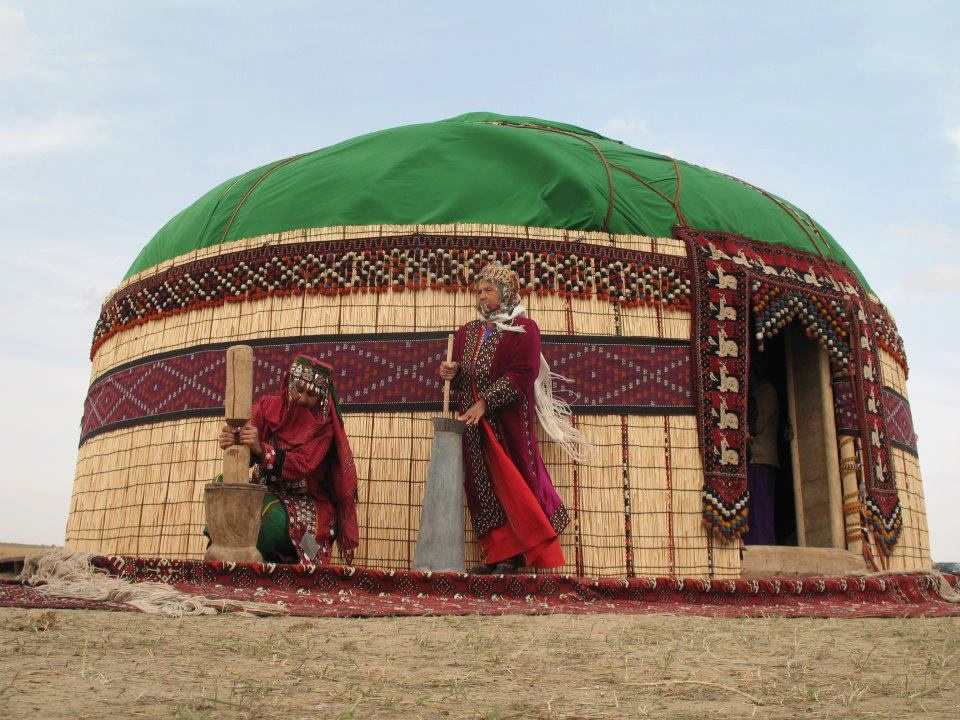
In a traditional yurt, the interior is organized rather than left as an undifferentiated open space. The location of household objects and the arrangement of different areas reflect established patterns of domestic activity and social relations. One description of Turkmen yurt interiors notes that the women’s area was commonly situated to the right of the entrance and associated with kitchen utensils, bedding, bags, and other household objects, while the left side was associated with men’s belongings and equipment. Such arrangements varied, but they demonstrate how the interior could reflect the organization of everyday life. Source: Turkmen Yurt and Its Interior.
The hearth held particular importance in Turkmen domestic life. It was associated with the continuity and well-being of the household, and customs surrounding it expressed respect for the home and its ancestral traditions. The space around the hearth could be decorated with specially woven or felted pieces, including the ojakbashi, a mat placed near the fireplace. Such objects demonstrate how practical domestic furnishings could also carry symbolic and aesthetic significance.
The yurt was therefore more than a shelter. It was a domestic environment in which work, hospitality, family life, craft, and inherited customs came together. Its furnishings were not incidental decorations: they were part of the material culture through which household life was organized and cultural knowledge was maintained. At the same time, the organization of the home could reflect the social distinctions and expectations governing its inhabitants. The yurt offered a shared space for family life, but its internal arrangement also established areas associated with particular tasks and roles. For women whose daily activities were closely tied to the household, this domestic environment could be both a centre of knowledge and labour and a boundary around their social world.